
Agroforestry-Goat Farming Models: Integrating Crops, Trees and Livestock

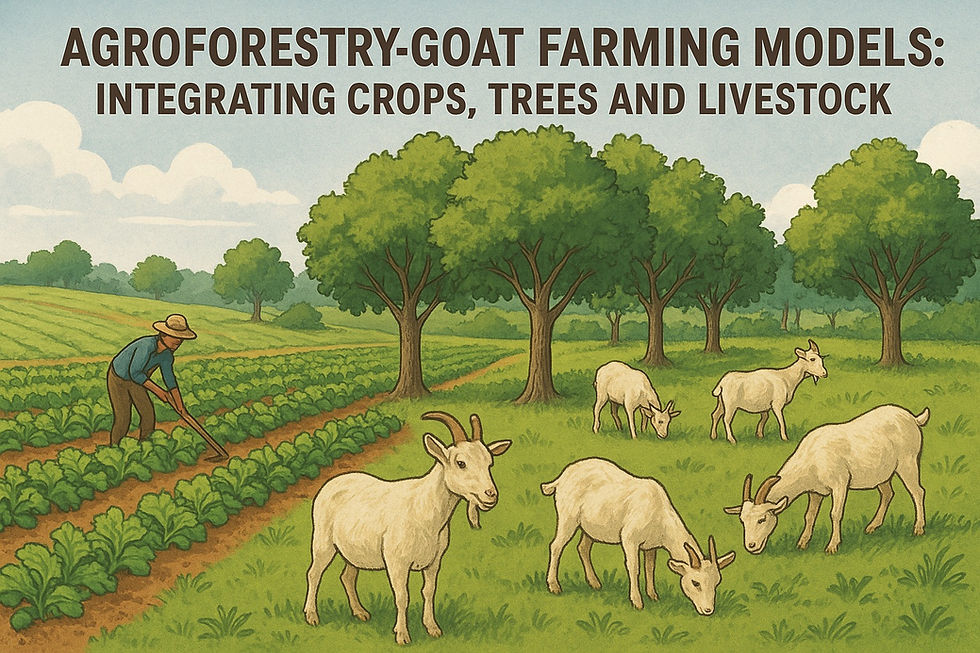
Goat farming has long been recognized as a resilient livelihood option for smallholder and marginal farmers. When combined with agroforestry systems, it creates a sustainable and diversified model that enhances productivity, strengthens climate resilience and improves rural incomes. The integration of crops, trees and livestock not only optimizes resource use but also builds ecological balance—making it a win-win model for both farmers and the environment.
Why Agroforestry-Goat Farming?
Resource Efficiency: Trees provide fodder, shade and fuelwood; goats convert otherwise underutilized biomass into meat, milk and manure; crops benefit from improved soil fertility.
Climate Resilience: Trees act as carbon sinks, improve microclimates and protect soil and water resources, while diversified outputs reduce risks from crop failure.
Income Diversification: Farmers gain multiple revenue streams—from goats, crops, timber, fruits and manure—reducing dependency on a single source.
Key Models of Integration
a. Silvopastoral Model: Combining goats with fodder trees and grasses on the same land.
Trees like Leucaena, Subabul, Sesbania and Acacia provide nutritious leaf fodder.
Understory grasses support rotational grazing.
Improves soil organic matter through manure and ensures fodder availability round the year.
b. Crop-Livestock-Tree Model: A mixed farming system where goats graze on crop residues and tree leaves, while manure enriches soil fertility for crops.
Suitable for smallholders with limited land.
Goats utilize crop byproducts (pulses husk, vegetable residues).
Enhances crop yields while reducing fertilizer costs.
c. Orchard-Goat Integration: Fruit orchards combined with controlled goat grazing.
Goats feed on weeds, reducing the need for chemical weeding.
Manure supports tree growth and soil holding with root growth.
Works best with fencing and rotational grazing to protect young plants.
Economic and Environmental Benefits
Higher Returns: Integrated systems generate year-round income from multiple sources.
Sustainable Fodder Supply: Reduces dependence on external feed markets.
Soil Fertility: Goat manure improves soil organic carbon, enhancing crop productivity.
Biodiversity & Conservation: Promotes local tree species and balanced ecosystems.
Challenges and Considerations
Need for fencing and controlled grazing to prevent crop/tree damage.
Initial investment in tree plantation and fodder development.
Training farmers in integrated management practices.
Market linkages for diversified products (goat meat, fruits, timber, manure).
Way Forward
Promoting Agroforestry-Goat Farming Models through farmer-producer organizations (FPOs), women’s groups and tribal cooperatives can accelerate adoption. Policy incentives, such as subsidies for fodder tree plantations, carbon credit schemes and training programs, can make the model more attractive.
Agroforestry-goat farming models demonstrate how crops, trees and livestock can coexist productively on small farms. They offer a pathway toward sustainable agriculture, ensuring food security, environmental protection and enhanced farmer livelihoods. As climate uncertainties rise, such integrated approaches are not just beneficial—they are essential for the future of rural farming communities balance ecology and environment.


Comments