
Beyond Subsidies: Investing in Knowledge Systems for Small Livestock Farmers in India
- TGT GLOBAL Development services
- Jan 27
- 3 min read

For decades, India’s livestock development strategy has largely revolved around input subsidies—free animals, feed support, medicines and infrastructure grants. While these interventions have provided short-term relief, they have often failed to create self-reliant, resilient small livestock enterprises, particularly among goat, sheep, backyard poultry and pig farmers. The missing link is not finance alone, but knowledge systems that enable farmers to make informed, adaptive and market-oriented decisions.
The Limits of Subsidy-Driven Livestock Development: Subsidies address what farmers receive, but rarely how they manage. In the absence of strong knowledge support, common outcomes include:
High mortality due to poor preventive health practices
Sub-optimal feeding and fodder management
Distress sale of animals during lean seasons
Limited adoption of improved breeds or practices
Weak linkage with markets and value chains
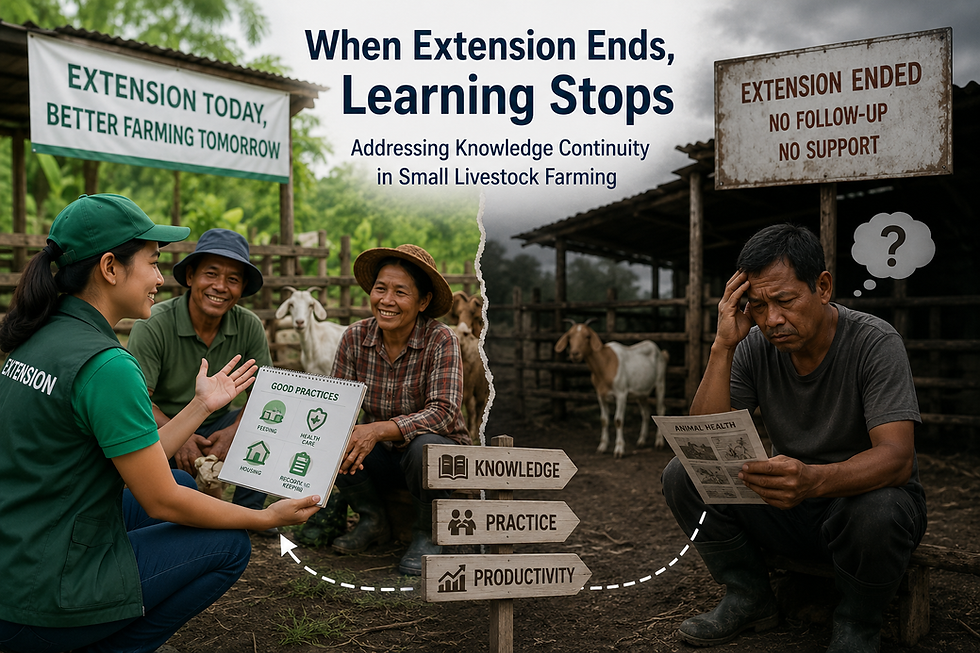
Evidence from field programs shows that when technical handholding ends, productivity often declines—highlighting that assets without knowledge depreciate rapidly.
Why Knowledge Systems Matter in Small Livestock Farming: Small livestock farming is management-intensive, not input-intensive. Marginal farmers operate under:
Climatic variability
Limited land and fodder resources
Informal markets
High disease risks
In such contexts, timely, contextual and continuous knowledge becomes the most critical input. A robust knowledge system empowers farmers to:
Prevent disease rather than react to outbreaks
Optimize local feed resources
Improve reproductive efficiency
Align production with market demand
Adapt to climate stress and seasonal shocks
What Do We Mean by ‘Knowledge Systems’?: Knowledge systems go beyond one-time training programs. This includes:
Community-Based Human Resources: Trained cadres such as Pashu Sakhis, master goat rearers and para-vets who provide doorstep advisory and act as local problem solvers.
Structured Capacity Building Pathways: Modular learning covering animal husbandry, enterprise planning, financial literacy, climate resilience and market engagement—delivered over time.
Contextual Learning Materials: Local language manuals, visual guides, seasonal calendars and decision-support tools aligned with agro-climatic zones.
Digital & Hybrid Platforms: Mobile-based advisory, helplines, WhatsApp learning groups and digital record-keeping to extend reach and continuity.
Institutional Linkages: Strong coordination between farmers, veterinary services, producer groups, NGOs, research institutions and markets.
From Beneficiaries to Decision-Makers: When farmers are treated only as subsidy recipients, dependency deepens. Knowledge systems, however, transform farmers into decision-makers and entrepreneurs. Programs that invest in continuous learning demonstrate:
Lower mortality rates
Higher adoption of preventive health practices
Improved income stability
Stronger participation of women and youth
Greater sustainability of interventions post-project
This shift is especially critical for women-led livestock systems, where knowledge access directly translates into household nutrition, income control and social empowerment.
The Role of Institutions, CSR and Development Agencies: To move beyond subsidies, stakeholders must:
Allocate dedicated budgets for training, mentoring and handholding
Measure success through behavior changes and productivity, not asset distribution
Invest in trainer development and local knowledge champions
Support long-term engagement models rather than short project cycles
Integrate livestock knowledge systems into climate adaptation and livelihood missions
CSR initiatives, in particular, have an opportunity to treat knowledge as social infrastructure, delivering returns far beyond the life of the project.
Policy Implications: Knowledge as Core Livestock Infrastructure: Just as roads and irrigation are essential for agriculture, knowledge systems must be recognized as core infrastructure for livestock development. This calls for:
National and state-level capacity building frameworks for small livestock
Standardized yet adaptable training curricula
Recognition and incentivization of community livestock service providers
Integration of knowledge metrics into scheme evaluations
Knowledge Is the Most Sustainable Subsidy: Subsidies may help farmers startup, but knowledge helps them to sustain, scale and succeed. For India’s millions of small livestock farmers, especially in rainfed and tribal regions, investing in knowledge systems might looks not optional— but it is essential.
If India is serious about doubling farmer’s incomes, building climate resilience and empowering women and youth, the future of livestock development must move beyond subsidies to sustained learning ecosystems.


Comments