
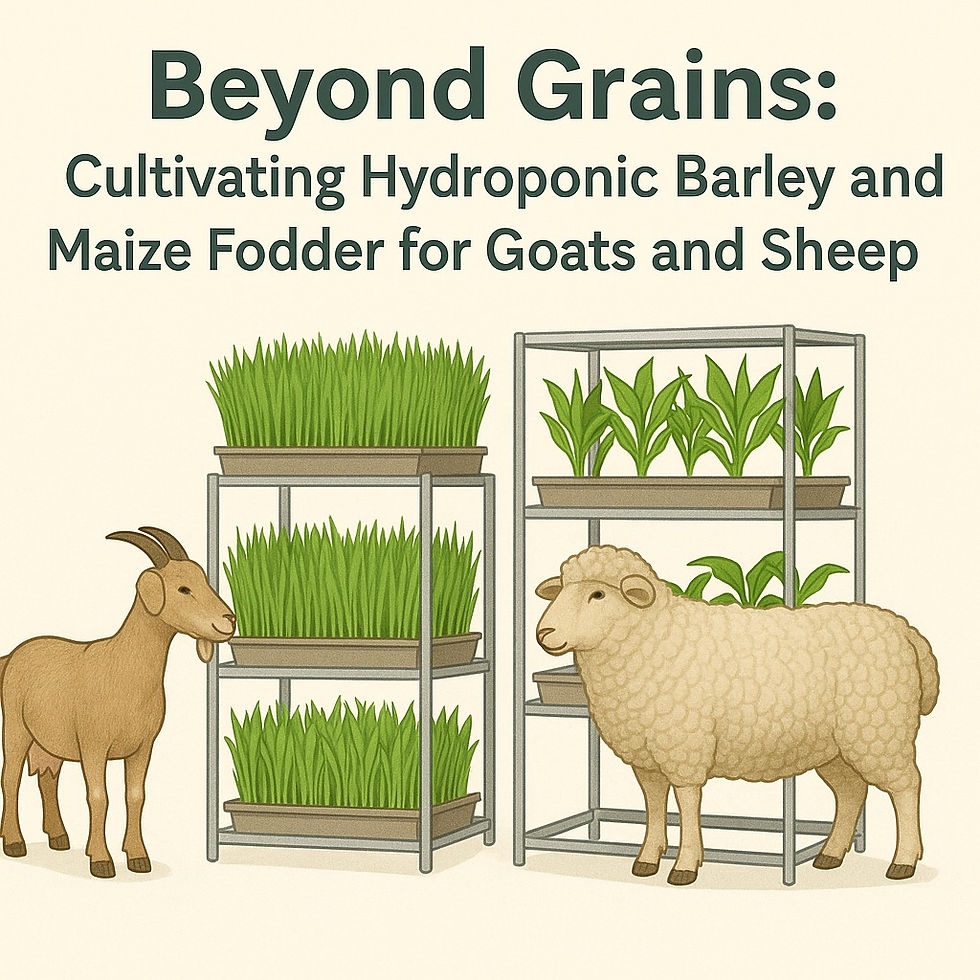
Beyond Grains: Cultivating Hydroponic Barley and Maize Fodder for Goats and Sheep

India’s small livestock sector—especially goat and sheep farming—serves as a backbone for many rural and marginal households. However, rising feed costs, unpredictable rainfall, and shrinking grazing lands have made traditional fodder systems increasingly unsustainable. In response, a quiet revolution is sprouting—literally. Hydroponic fodder cultivation, particularly using barley and maize, is emerging as a cost-effective, climate-resilient solution for small livestock farmers across India.
Hydroponics is a soilless method of growing plants using minimal water and controlled environments. When applied to fodder production, it involves sprouting grains—mainly barley, maize, or wheat—into lush green fodder mats within 7 to 10 days. These mats are highly nutritious and digestible, making them ideal for small ruminants like goats and sheep.
Among the various grains used, barley and maize stand out due to their high germination rates, excellent nutrient profiles, and accessibility in the Indian context. Here's why:
Barley fodder is rich in energy and digestible fiber, making it ideal for lactating does and ewes.
Maize fodder offers higher protein content and palatability, supporting growth in young stock and fattening of market-ready animals.
Benefits:
Improved Nutrition, Better Health: Hydroponic fodder is rich in essential nutrients—proteins, enzymes, vitamins A, B, and C—and has better digestibility than traditional dry fodder. This leads to:
Improved milk yield in goats and sheep
Faster weight gain in kids and lambs
Healthier animals with improved immunity
Water Efficiency: Hydroponic systems use 90% less water compared to conventional fodder crops, making them ideal for drought-prone and semi-arid areas of India.
Space-Saving & Landless Friendly: With just a few square feet of space and no need for soil, even landless and marginal farmers can grow fodder next to their homes or animal sheds.
Quick Turnaround: Barley or maize fodder matures in 7 days, ensuring a consistent and reliable feed source throughout the year—regardless of season or rainfall.
Implementation Challenges: Despite its potential, adoption remains limited due to:
Initial setup cost of Rs. 8,000–15,000 for small-scale units
Need for training in hygiene and maintenance
Limited awareness in remote villages
However, these challenges are being addressed through:
NGO and CSR-supported demonstration units
Inclusion of hydroponics in livestock extension services
Government support under fodder development schemes
To scale this innovation, the following steps are crucial:
Capacity building of frontline workers like Pashu Sakhis
Subsidized units and revolving funds for SHGs and FPOs
Integration into rural livelihoods programs and animal husbandry policies
Hydroponic barley and maize fodder is not just a technical innovation—it is a livelihood enabler. For India’s small livestock farmers, especially in resource-poor settings, going “beyond grains” into hydroponic systems could mean going beyond poverty.


Comments