
Digital Advisory and Data-Based Livestock Management for Farmers

The livestock sector plays a crucial role in the rural economy of India, providing income, nutrition and livelihood security to millions of smallholder farmers. However, traditional livestock management practices often face challenges such as disease outbreaks, poor productivity, lack of timely veterinary support and limited market access. In recent years, digital technology and data-driven advisory systems have emerged as promising solutions to address these challenges and improve livestock management for farmers.
The Need for Digital Livestock Advisory: Most rural livestock farmers depend on traditional knowledge or informal sources for animal health care and farm management decisions. While local knowledge is more valuable looking to the increasing complexity of livestock production—driven by climate change, emerging diseases and market dynamics—requires access to timely and reliable information.
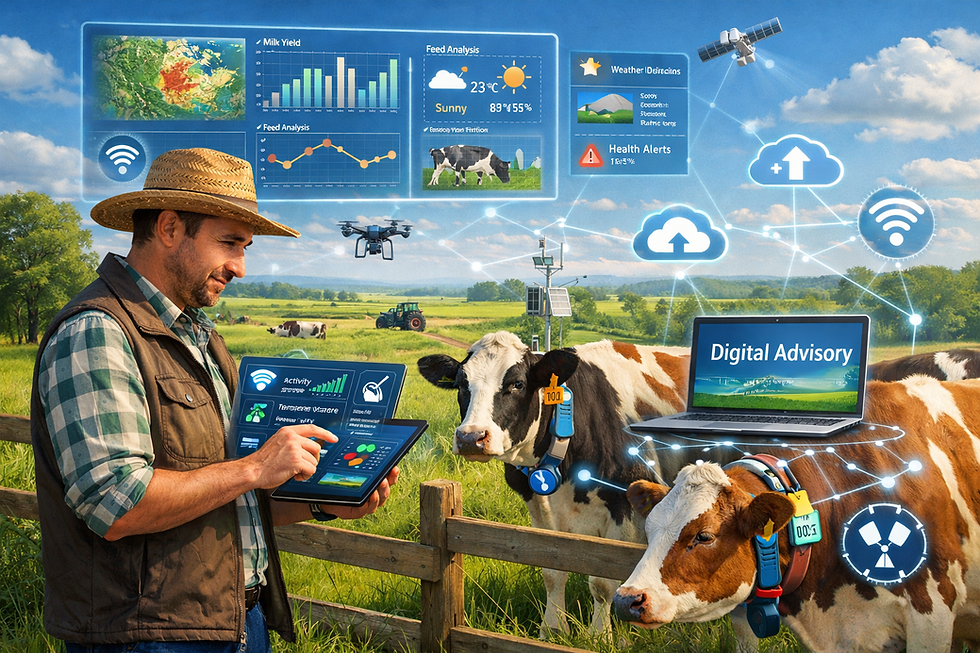
Digital advisory systems can bridge this gap by delivering real-time information to farmers through mobile phones, digital platforms and tele-veterinary services. These platforms can guide farmers on animal health management, feeding practices, breeding, disease prevention and market opportunities.
The Role of Data in Livestock Management: Data-based livestock management allows farmers and service providers to make informed decisions using systematic information about animals and farm operations. By collecting and analyzing data related to animal health, productivity, breeding cycles and feeding patterns, farmers can significantly improve the efficiency and profitability of their livestock enterprises.
For example, maintaining digital records of livestock—such as vaccination history, breeding details, weight gain and milk or meat production—helps farmers monitor animal performance and take timely actions when problems arise.
Data also helps development organizations, veterinary service providers and policymakers to understand trends in livestock diseases, productivity levels and resource availability in rural areas. This can support better planning and targeted interventions.
Tele-Veterinary Services: Expanding Access to Animal Healthcare: One of the most impactful digital innovations in livestock management is the emergence of tele-veterinary services. Through mobile phones, video calls and messaging platforms, farmers can connect virtually with local veterinary experts without traveling long distances.
Tele-vet platforms allow farmers to share images or videos of sick animals, receive preliminary diagnosis and get immediate advice on treatment or management. This approach is particularly beneficial in remote villages where veterinary infrastructure is limited.
Such systems also helps to create valuable databases of livestock health issues, enabling early detection of disease outbreaks and improving disease surveillance systems.
Digital Tools for Livestock Farmers: Several digital tools are gradually transforming livestock management in rural India:
Mobile advisory apps providing information on feeding, breeding and disease control
Digital herd management systems for tracking animal records and productivity
Tele-veterinary helplines connecting farmers with veterinary professionals
Market information platforms providing price updates and buyer connections
Remote monitoring technologies for farm and animal management
These tools empower farmers with knowledge and enable better decision-making at the farm level.
Benefits for Small Livestock Farmers: Digital advisory and data-based management systems offer several advantages for small livestock farmers:
Improved animal health through early disease detection
Better productivity and reproductive management
Reduced costs through efficient feeding and management practices
Improved access to veterinary services and technical guidance
Enhanced market linkages and income opportunities
For farmers involved in goat, sheep, dairy or poultry farming, these technologies can significantly enhance farm sustainability and profitability.
Challenges in Adoption: Despite the potential benefits, several barriers limit the adoption of digital livestock technologies in rural areas. These include low digital literacy among farmers, limited internet connectivity, language barriers and lack of awareness about available digital services.
In addition, many digital platforms are not specifically designed for smallholder livestock systems, making them less accessible or relevant for rural farmers.
The Way Forward: To fully realize the potential of digital livestock management, there is a need for collaborative efforts among governments, research institutions, private technology companies and development organizations. Capacity-building programs can help farmers understand and use digital tools seamlessly and effectively.
Community-based digital interphase and facilitators, farmer producer organizations and social enterprises can also play a key role in expanding the reach of digital advisory services.
In the future, integrating artificial intelligence, data analytics and remote sensing technologies with livestock management systems could further enhance farm productivity and resilience.
Digital advisory and data-based livestock management have the potential to transform livestock farming in rural India. By combining traditional knowledge with modern technology, farmers can make better decisions, improve animal health and increase their income.
For millions of small livestock farmers, digital tools are not just technological innovations—they represent an opportunity to build more resilient, efficient, affordable and sustainable livestock-based livelihoods in the face of emerging local and global challenges.


Comments