
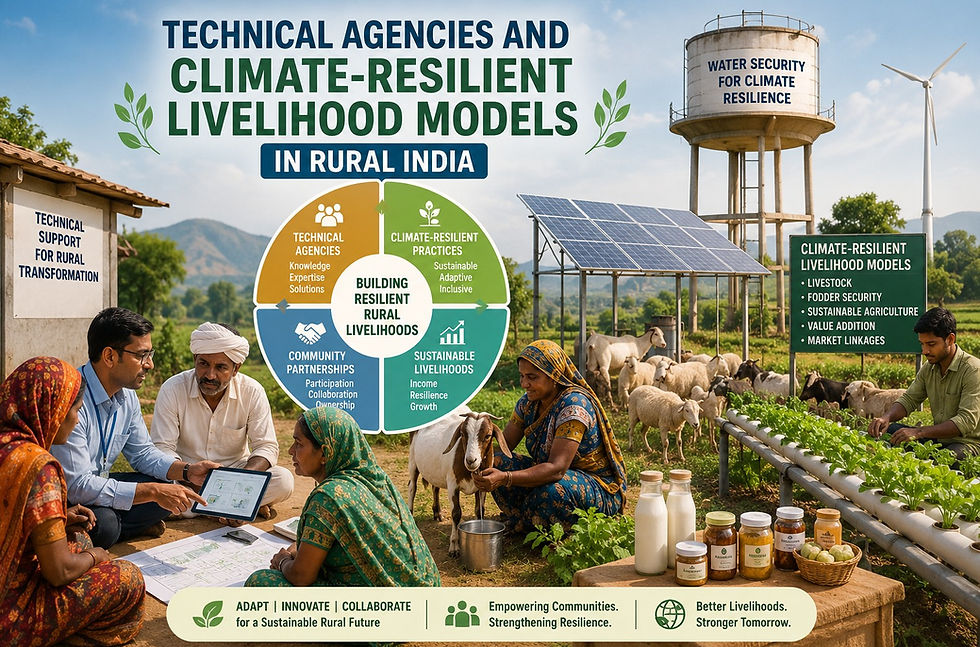
Technical Agencies and Climate-Resilient Livelihood Models in Rural India

Climate change is no longer a future risk for rural India—it is a present-day livelihood crisis. Erratic rainfall, prolonged droughts, rising temperatures, fodder scarcity and frequent disease outbreaks are directly affecting farm and livestock-based incomes. In this scenario, climate-resilient livelihood models are not optional innovations; they are survival strategies.
However, designing and sustaining such models requires more than funding or intent. This is where technical agencies play a critical role, acting as the backbone of climate-smart livelihood interventions.
Why Climate Resilience Is Central to Rural Livelihoods: Most rural households depend on rainfed agriculture, small livestock, forests and common property resources. Climate stress impacts them in multiple ways:
Crop failures and reduced biomass for fodder
Increased mortality and low productivity in livestock
Water scarcity affecting agriculture, animal health and hygiene
Higher vulnerability of women and landless households
Traditional coping mechanisms are increasingly inadequate. Climate resilience demands scientific planning, localized solutions and continuous technical handholding.
Who Are Technical Agencies?: Technical agencies are specialized institutions that provide domain expertise, system design, capacity building and technical backstopping. They may include:
Sector-specific technical organizations (agriculture, livestock, fisheries)
Research-linked NGOs and knowledge institutions
Livelihood technical support agencies engaged by CSR or government programs
Their role goes far beyond training—it spans the entire project lifecycle.
Core Roles of Technical Agencies in Climate-Resilient Livelihoods:
1. Climate-Sensitive Livelihood Design: Technical agencies analyze:
Agro-climatic zones and vulnerability profiles
Local resource availability (fodder, water, breeds, biomass)
Risk exposure of different livelihood options
Based on this, they design low-risk, climate-adaptive livelihood models, such as:
Small ruminants (goat, sheep) over large livestock in drought-prone areas
Backyard poultry and mixed farming systems
Diversified income models combining livestock, fodder and value addition
2. Scientific Package of Practices (PoP): Climate resilience depends on how livelihoods are practiced. Technical agencies introduce:
Breed selection suited to heat and disease resistance
Climate-smart housing and water-efficient shed designs
Season-wise feeding and fodder planning using local resources
Preventive healthcare and biosecurity protocols
This scientific rigor reduces climate-induced losses and stabilizes incomes.
3. Capacity Building Beyond Classroom Training: One-time training fails under climate stress. Technical agencies provide:
Hands-on, field-based learning
Continuous mentoring and refresher support
Problem-solving during extreme events (heat waves, disease outbreaks)
This embedded technical support builds confidence and adaptive capacity among community members, especially women.
4. Resource Optimization and Local Solutions: Climate resilience is about doing more with less. Technical agencies promote:
Use of locally available feed and fodder
Community fodder banks and drought reserves
Low-cost technologies and indigenous practices validated scientifically
This reduces dependence on external inputs and enhances sustainability.
5. Risk Management and Livelihood Stabilization: Technical agencies help identify and manage risks through:
Early warning and preparedness measures
Disease surveillance and vaccination planning
Mortality reduction strategies and productivity optimization
Such interventions are crucial for protecting livelihoods during climate shocks.
6. Market Linkages and Value Addition: Climate resilience is incomplete without income security. Technical agencies support:
Aggregation and market-oriented production planning
Value-added products (goat milk products, poultry processing, manure-based inputs)
Linkages with buyers, FPOs and local markets
Diversified income streams help households absorb climate-related income fluctuations.
Why CSR and Development Programs Need Technical Agencies: Many livelihood projects fail not due to lack of funding, but due to:
Poor technical design
Inadequate technical handholding
Absence of climate-risk planning
Non onboarding Technical Agency
Technical agencies help de-risk investments, ensure quality implementation and convert short-term projects into long-term climate-resilient livelihood ecosystems.
From Projects to Systems: Climate resilience cannot be achieved through isolated interventions. It requires:
Long-term technical engagement
Integration of climate science with local knowledge
Strong collaboration between CSR, government, implementing NGOs and technical agencies
Technical agencies act as system integrators, ensuring that climate-resilient livelihoods are scalable, replicable and sustainable.
In the era of climate uncertainty, technical agencies are no longer support actors—they are central to livelihood success. By combining scientific knowledge, field realities and continuous handholding, they enable rural communities to not just survive climate change, but adapt and thrive.
Climate-resilient livelihoods are built on technical foundations—and technical agencies are the architects.


Comments