
India’s Goat Value Chain: Where Are the Missing Links?

India’s goat sector is at an interesting crossroads. Goats are no longer just a household asset kept for emergency cash needs; they are increasingly becoming an important component of rural enterprise, food systems and women-led livelihoods. India had about 148.88 million goats according to the 20th Livestock Census, with goats accounting for around 27.8% of the country’s livestock population. The goat population increased by 10.14% between 2012 and 2019. Yet, despite this scale, a fundamental question remains: Why does the goat farmer still capture only a limited share of the value generated along the goat value chain?
The answer lies not in one missing component, but in a series of interconnected gaps—from breeding and feed to livestock health, aggregation, finance, markets, processing and value addition.
The Goat Value Chain (More Than Just Goat Rearing): A goat value chain begins long before a farmer purchases or breeds a goat and continues well beyond the sale of a live livestock. It includes:
Inputs → Breeding → Feeding → Improved Management Practices → Housing & Sanitation → Livestock Health → Production → Aggregation → Trading → Transport → Slaughter/Processing → Retail → Consumer
At each stage, different actors create value and earn income. However, the smallholder farmer—who carries much of the production risk—often has the weakest negotiating position. This is particularly important because goats are predominantly kept by small and marginal farmers. A recent MANAGE publication notes that more than 76% of goats are owned by marginal and small farmers with less than two hectares of land.
The opportunity, therefore, is not simply to increase goat numbers. The real opportunity is to increase the value generated per goat and the share retained by the producer.
1. The First Missing Link: Quality Breeding Services: Productivity begins with the livestock itself. Many smallholders still depend on locally available breeding bucks and uncontrolled mating. This can result in slow genetic improvement, poor growth rates and inconsistent production.
Quality breeding services—including access to superior bucks, breed selection, controlled breeding and appropriate reproductive management—need to reach farmers at the village level.
The challenge is not necessarily the absence of technology. India has considerable scientific and technical knowledge related to goat breeding. The bigger challenge is last-mile door step delivery and adoption. A sustainable goat value chain therefore needs to move from:
“Goat distribution” → “Productive goat asset development.”
2. Feed and Fodder (The Silent Constraint): Feed is one of the most important determinants of goat productivity. Goats are often considered low-input livestock, but “low-input” should not mean “low-nutrition.” Poor-quality feed, seasonal fodder shortages and inadequate supplementation directly affect growth, reproduction, immunity and profitability. Climate variability is making this challenge even more significant.
The future goat value chain needs greater emphasis on:
Locally available fodder resources
Fodder planning
Crop-residue utilisation and management
Nutritional supplementation
Silage and fodder conservation
Low-cost feed formulation
Community-based feed enterprises
Climate-resilient fodder systems
Feed security is ultimately income security.
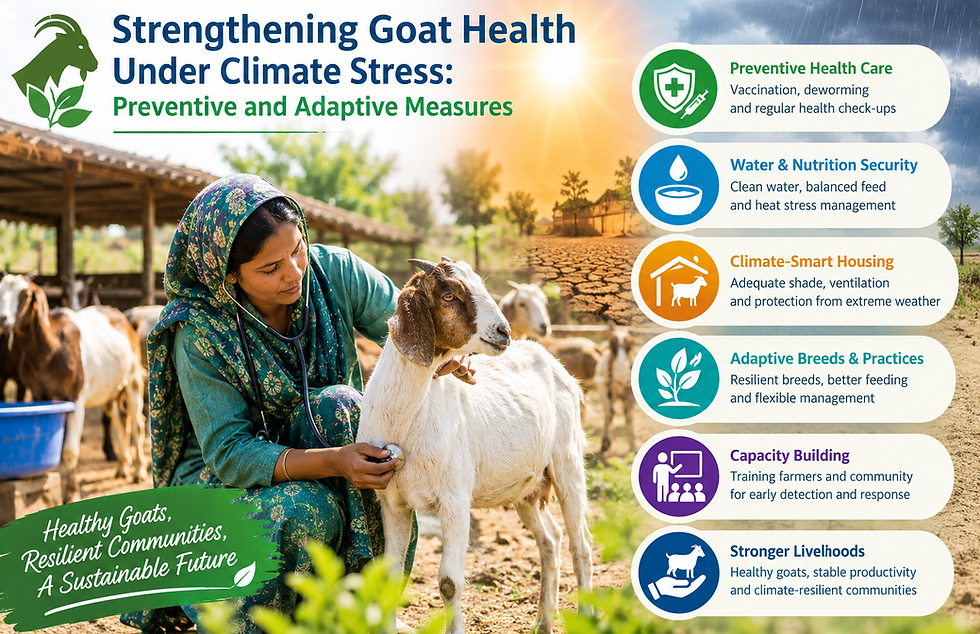
3. Livestock Health (Moving from Treatment to Prevention): Livestock health remains one of the biggest economic risks for goat farmers. Disease outbreaks, high kid mortality, parasitic infections and delayed access to veterinary services can wipe out a substantial portion of household investment. Earlier research in Bihar, Odisha and Uttar Pradesh documented significant goat mortality and highlighted the need for assured breeding, healthcare, financial support and stronger value-chain services.
The sector therefore needs to move from a “treatment-after-disease” model towards a preventive livestock health model.
Village-level livestock service providers can play an important role by connecting farmers with vaccination, deworming, early disease identification, referral services and improved husbandry practices.
4. The Missing Link Between Farmer and Market: Perhaps the most visible weakness in the goat value chain is market linkage. Individual farmers generally sell small numbers of goats. Traders, aggregators and middlemen often have better information about prices, demand, weight and market conditions. This creates an information and bargaining imbalance.
In several regions, farmers continue to sell goats directly within or around their villages. Research from Bihar, Odisha and Uttar Pradesh found that more than 80% of goat keepers sold goats in their villages. The question is therefore not:
“Are there goat markets?”- Yes
The more important question is:
“Can farmers participate in those markets with better information, aggregation and bargaining power?”
5. From Visual Estimation to Weight-Based Pricing: Another important opportunity is scientific pricing. Traditional goat trading often relies heavily on visual assessment—body size, breed, appearance and negotiation skills. This can disadvantage farmers who lack market knowledge.
Weight-based pricing, digital weighing, mobile-based price information and transparent procurement systems can help create a more objective market. A farmer should ideally know:
Live weight × prevailing market price = estimated value
rather than depending entirely on a trader's assessment and valuation. This seemingly simple shift can significantly improve transparency.
6. Aggregation (The Power of Collective Selling): A farmer with 2–5 goats has limited bargaining power. A producer group with 100–500 market-ready goats has considerably more. This makes aggregation one of the most important missing links in the goat value chain. Farmer Producer Organisations, producer groups, cooperatives and community livestock enterprises can potentially support:
Collective procurement of inputs
Bulk sale of goats
Market information
Transportation
Weight-based pricing
Negotiation with institutional buyers
Access to finance
Processing and value addition
The goal should not simply be to create another farmer institution. The institution must have a clear economic function.
7. Finance (The Invisible Infrastructure): Goat farming requires working capital—for feed, medicines, breeding livestock, sheds, transportation and expansion. Yet small livestock producers often face difficulties accessing suitable financial products. Financial institutions need to recognise that goat enterprises have their own production cycles and risk profiles. Instead of treating goats simply as individual livestock, financial products could be designed around:
Herd + cash flow + production cycle + market linkage.
Insurance, credit and working-capital products can become much more effective when combined with technical support and market access.
8. Processing and Value Addition (The Biggest Untapped Opportunity?): India's goat economy is heavily oriented towards the sale of live livestock. But value can be created beyond the live goat. Potential areas include:
Hygienically processed goat meat
Branded goat meat
Ready-to-cook products
Goat milk and milk products
Hygienic packaging
Goat manure
Skins and hides
Other by-products
Export Potential: India exported 11,581.07 MT of sheep and goat meat worth USD 84.94 million in FY 2024–25, with major destinations including the UAE, Qatar, Kuwait, Bahrain and Oman. This demonstrates that there is already an external market—but the larger opportunity is to develop efficient domestic and regional value chains that connect producers with organised markets.
9. The Missing Digital Layer: The next generation of goat value chains will increasingly depend on information. Digital tools can support in:
Farmer registration
Livestock identification
Weight recording
Health records
Vaccination reminders
Market prices
Buyer-seller connections
Digital payments
Business analytics
Traceability
The objective should not be to introduce technology simply because it is available. The objective should be:
“Use technology to solve a real value-chain problem.”
A simple digital weight-and-price tool may create more value for a farmer than a complicated application that nobody uses.
10. The Role of Women (From Livestock Caretaker to Entrepreneur): Goat rearing has traditionally involved significant participation by rural women. The next step is to recognise women not merely as livestock caretakers, but as economic actors in the value chain. The Pashu Sakhi model demonstrates the potential of village-level women livestock service providers to bridge the gap between technical knowledge and farmers. The future could be:
Pashu Sakhi → Sustainable Pashu Sakhi → Livestock Entrepreneur → Community Livestock Enterprise
This transition requires business skills, market understanding, financial literacy and access to enterprise opportunities—not only technical livestock training. Research has also identified value-chain development as an important pathway for strengthening rural women's participation and economic empowerment in goat-based livelihoods.
Where Are the Missing Links?: The Indian goat value chain can be visualised as follows:
Value Chain Stage | Existing Situation | Major Missing Link |
Breeding | Local breeding dominates many systems | Quality breeding services & Recording |
Feed & Fodder | Grazing and locally available resources | Scientific nutrition & fodder planning |
Health | Veterinary services available unevenly | Preventive, last-mile services |
Production | Millions of smallholders | Professional farm management |
Aggregation | Mostly individual sales | Farmer aggregation |
Pricing | Negotiation/visual estimation | Weight-based transparent pricing |
Market | Traders dominate many local markets | Direct & organised market linkage |
Finance | Limited suitable products | Livestock-specific financial services |
Processing | Large live-livestock trade | Local/regional value addition |
Digital | Emerging technologies | Practical digital solutions |
Entrepreneurship | Livestock as livelihood | Livestock as sustainable enterprise |
What Should the Future of Goat Value Chain Look Like?: India does not necessarily need a completely new goat value chain. It needs a better-connected value chain. A future-oriented model could look like this below:
Productive Goat + Quality Feed + Preventive Health + Skilled Farmer + Village Livestock Service + Digital Information + Farmer Aggregation + Transparent Pricing + Organised Market + Value Addition
The emphasis should shift from “more goats” to “more value per goat.”
This is an important distinction. Increasing goat numbers without improving productivity, mortality, market access and farmer margins can increase the size of the sector without proportionately increasing farmer prosperity.
From Goat Farming to Goat Enterprise: The next decade could see a major transformation in India's goat sector. Goat farming can evolve from a traditional livelihood activity into a network of interconnected rural enterprises:
Pashu Sakhi enterprises
Community livestock service centres
Feed enterprises
Kid nurseries
Buck service enterprises
Goat aggregation centres
Livestock producer organisations
Goat meat processing units
Goat dung Manure enterprises
Digital livestock platforms
This creates an opportunity to build not only farmers, but also a new generation of rural livestock entrepreneurs. India's goat sector has the scale, adaptability and market demand required to become a stronger pillar of rural livelihoods. The country has nearly 149 million goats, a large smallholder base and an established domestic and export market. But the real challenge is connectivity across the value chain. The missing links are not only physical infrastructure. They include knowledge, services, aggregation, finance, information, technology, entrepreneurship and market institutions. If these links are strengthened, the goat can become much more than a household asset.
It can become a productive investment, a source of women's entrepreneurship, a vehicle for rural enterprise and an important contributor to India's inclusive livestock economy. The future of India's goat sector will not be determined simply by how many goats we rear—but by how much value we create from every quality productive goat and how much of that value reaches the farmer.



Comments