
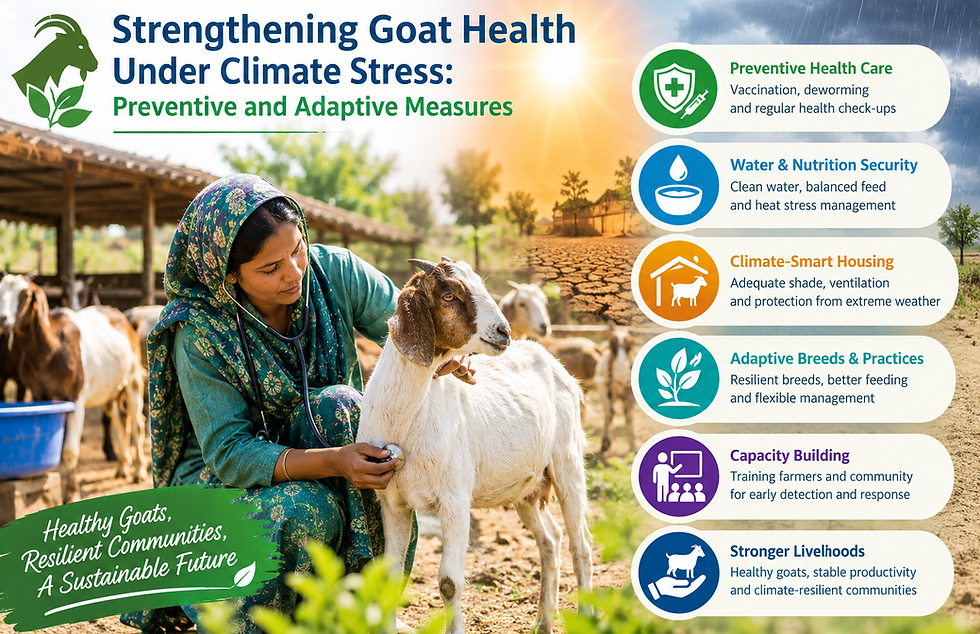
Strengthening Goat Health Under Climate Stress: Preventive and Adaptive Measures

Climate change is emerging as one of the biggest threats to small livestock systems across rural India and the world. Rising temperatures, extended droughts, unpredictable rainfall and increased disease outbreaks are putting immense stress on goats—an otherwise hardy and adaptable species. To protect productivity and ensure sustainable livelihoods, goat farmers must adopt preventive and adaptive measures that directly address climate-linked health challenges.
This article highlights practical, low-cost and climate-smart approaches to safeguarding goat health under increasing environmental stress.
Climate Stress: How It Affects Goat Health: Goats are resilient animals, but extreme climatic conditions affect their normal physiology and health.
Key climate-related health impacts:
Heat stress leading to reduced feed intake and milk production
Dehydration and electrolyte imbalance
Higher parasite loads due to warmer and humid conditions
Respiratory infections during sudden weather shifts
Weak immunity caused by prolonged stress
Reproductive problems during heatwaves
Low kid survival, especially during extreme cold or heat
Understanding these challenges helps farmers take timely action.
Preventive Measures to Protect Goat Health:
Improve Shelter for Heat and Cold Protection: Proper housing is the first line of defence.
Provide well-ventilated sheds with good airflow
Use raised floors to avoid dampness and infections
Add thatch, bamboo mats or shade nets on roofs
Avoid overcrowding
Provide warm bedding (dry straw, gunny bags) during winter
Well-designed shelters reduce heat stress and respiratory diseases significantly.
Ensure Continuous Access to Clean Water: Under heat stress, goats drink 2–3 times more water.
Keep water cool and clean under shade
Clean troughs frequently
Add ORS-type solutions during extreme heat
Provide electrolyte supplements if available
Hydration prevents dehydration, reduces body heat and improves feed intake.
Balanced and Roughage-Rich Diet: A climate-resilient feeding plan strengthens immunity.
Provide green fodder, dry roughage and tree leaves
Include mineral mixtures + salt lick daily
Reduce high-concentrate feeds during peak heat (they generate body heat)
Provide energy-rich feed during cold seasons
A strong rumen = strong immunity.
Regular Deworming and Parasite Control: Warmer temperatures increase parasite multiplication.
Follow seasonal deworming schedule:
Pre-monsoon
Post-monsoon
Winter (if needed)
Maintain dry and clean bedding
Rotate grazing areas
Use lime and bleaching powder to control mites and ticks in sheds
Parasite control prevents anemia, weight loss and mortality.
Vaccinations to Prevent Disease Outbreaks: Climate stress increases disease susceptibility.
Essential vaccines include:
PPR (Peste des Petits Ruminants)
ET (Enterotoxaemia)
Goat Pox
FMD (as per local advisories)
Vaccination reduces mass losses in extreme climate years.
Adaptive Measures to Build Long-Term Resilience:
Promote Browsing-Based Feeding Systems: Goats naturally prefer shrubs and tree leaves, which survive heat and drought better than grasses. Plant drought-tolerant fodder trees:
Subabul
Gliricidia
Neem
Moringa
Khejri
Acacia species
These ensure feed supply even in seasonal fodder stress and continuity in availability of fodder round the year.
Water Harvesting and Small Storage Structures: Build small farm ponds, tanks or tarpaulin pits to secure drinking water for animals during dry spells.
Strategic Breeding for Climate Tolerance: Local and indigenous breeds tolerate heat and diseases better.
Examples:
Black Bengal – disease resistance
Sirohi – heat tolerance
Barbari – good adaptability
Jamunapari – strong growth in mixed climates
Encouraging local breeds builds resilience and preserve the selected local breed as progeny.
Community-Level Preparedness Systems: Strengthening goat health is not just an individual effort.
Community fodder banks
Shared water storage systems
Cluster vaccination programs
Pashu Sakhi–led disease monitoring
Collective action reduces losses during climate shocks.
Seasonal Health Calendar for Climate Protection:
Summer (Extreme Heat)
Provide shade and cool water
Reduce concentrates
Give electrolyte solutions
Avoid long-distance grazing
Deworm before monsoon
Monsoon (High Humidity)
Control internal and external parasites
Maintain dry bedding
Vaccinate against common diseases
Ensure shed ventilation
Winter (Extreme Cold)
Provide clean and luke warm drinking water
Provide warm bedding
Prevent cold stress in newborn kids
Increase energy-rich feed
Reduce moisture inside sheds
Climate and seasonal changes is a growing challenge, but goats remain one of the most climate-adapted livestock species. By adopting preventive measures (housing, vaccination, parasite control) and adaptive strategies (fodder trees, water management, resilient breeds), farmers can significantly strengthen goat health and reduce losses.
Healthy goats mean stable income, improved nutrition and stronger climate resilience for rural households.


Comments