
Life on the Edge: Small Livestock Farming in the Harsh Climate of the Thar Desert

The vast, golden stretches of the Thar Desert—spanning parts of western India and eastern Pakistan—represent one of the most challenging agro-ecological regions in the world. In districts like Jaisalmer, where rainfall is scarce, temperatures are extreme, and vegetation is sparse, conventional agriculture often fails. Yet, life persists—and thrives—through small livestock farming.
The Harsh Reality of Desert Farming: The Thar Desert is characterized by:
Low and erratic rainfall (100–300 mm annually)
Extreme temperatures, from scorching summers above 45°C to cold winter nights
Frequent droughts and water scarcity
Limited fodder availability
Under such conditions, crop farming is risky and often unsustainable. Small livestock—especially goats and sheep—offer a resilient alternative.
Why Small Livestock Matters: Goats and sheep are uniquely adapted to desert environments:
Drought tolerance and ability to survive on minimal water
Browsing behavior, allowing them to feed on shrubs and hardy desert vegetation
Low input requirements, making them accessible for marginal farmers
Quick reproduction cycles, ensuring faster returns
In regions like Jaisalmer, these animals are not just assets—they are a lifeline, providing meat, milk, manure, and regular income.
Indigenous Knowledge Meets Survival: Desert communities have, over generations, developed adaptive practices such as:
Seasonal migration (transhumance) to access better grazing areas
Ethno-veterinary treatments using local herbs
Strategic herd composition to balance risk and productivity
These traditional systems are deeply intertwined with the desert ecosystem, ensuring sustainability even in fragile conditions.
Emerging Challenges: Despite their resilience, small livestock systems in the Thar Desert face increasing pressures:
Climate change, intensifying droughts and heatwaves
Degradation of common grazing lands
Limited access to veterinary services and markets
Water stress affecting both animals and fodder availability
Without intervention, these challenges could threaten the livelihoods of thousands of pastoral families.
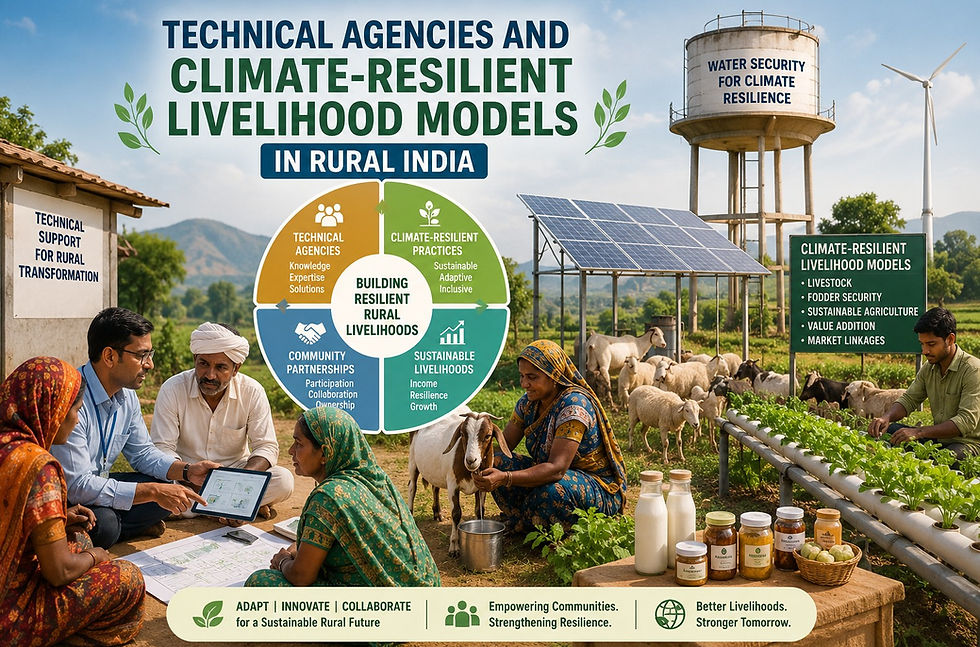
Pathways to Strengthening Desert Livelihoods: To support and scale small livestock farming in desert regions, a multi-pronged approach is essential:
1. Climate-Smart Livestock Practices
Fodder banks and drought-resilient forage species
Improved shelter designs to reduce heat stress
2. Capacity Building & Extension Services
Training farmers and community-based workers (like Pashu Sakhis)
Promoting scientific breeding and health management
3. Strengthening Value Chains
Organized meat and milk markets
Value addition (e.g., goat milk products, wool processing)
4. Water Resource Management
Rainwater harvesting structures
Efficient water use systems for livestock
5. Institutional Support & Community Models
Formation of producer groups, FPOs, and cooperatives
Integration with government schemes and CSR initiatives
A Model for Climate Resilience:
Small livestock farming in the Thar Desert is more than a survival strategy—it is a model of climate resilience. It demonstrates how low-resource, locally adapted systems can sustain livelihoods in the face of adversity.
As the world grapples with climate uncertainty, the lessons from desert communities in Jaisalmer offer valuable insights: resilience lies not in resisting nature, but in adapting intelligently to it.



Comments