
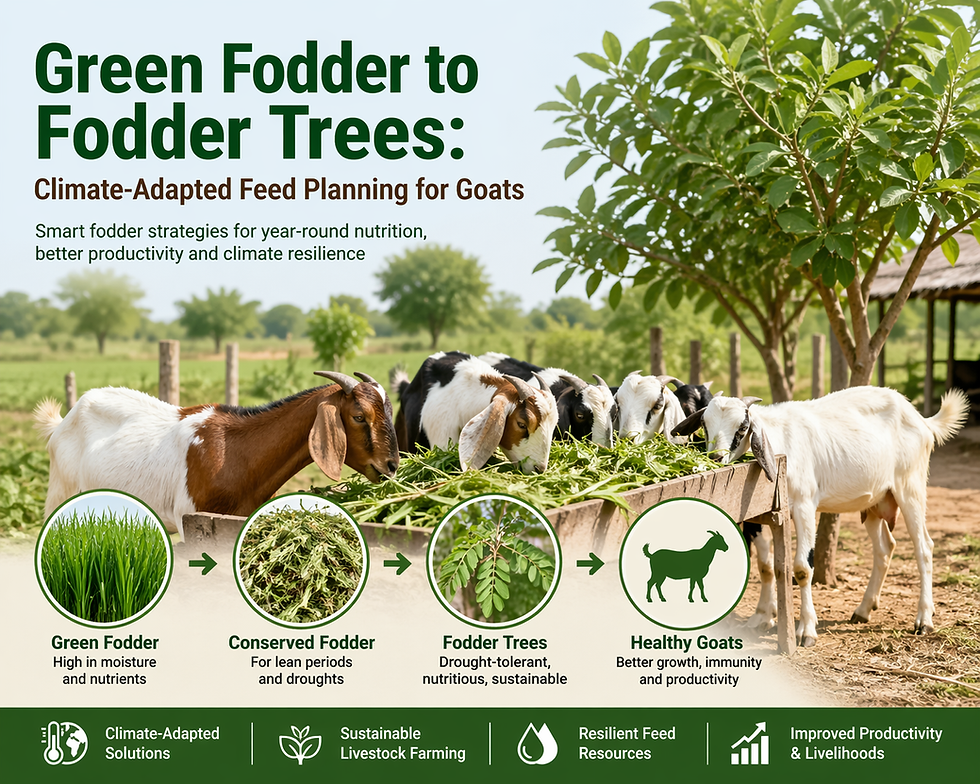
Green Fodder to Fodder Trees: Climate-Adapted Feed Planning for Goats

Climate change is bringing unpredictable rainfall, shrinking grazing spaces and seasonal fodder shortages across rural regions. For small livestock farmers, the key to maintaining healthy and productive goats lies in climate-adapted feed planning. One of the most effective and sustainable strategies is combining green fodder cultivation with the use of fodder trees, ensuring year-round nutrition at low cost.
This article highlights how integrating these two resources can make goat farming more resilient, sustainable and profitable.
Why Climate-Adapted Feed Planning Matters: Goats are naturally hardy animals, but climate-related challenges are increasing:
Irregular monsoons reduce green fodder availability
Droughts create long ‘lean fodder seasons’
Rising temperatures reduce pasture productivity
Farmers become more dependent on costly concentrates
A well-planned mix of green fodder + fodder trees + dry roughage builds a stable feeding system that can withstand climate shocks.
The Role of Green Fodder in Goat Nutrition: Green fodder is rich in moisture, nutrients and palatability. It supports:
Better digestion
Improved milk yield
Healthy growth in kids
Enhanced immunity
Climate-resilient green fodder options for goats:
Napier–CO4 / CO5: High biomass, year-round product
Guinea Grass: Survives heat and low rainfall
Hedge Lucerne (Velimasal): Rich in protein
Stylo (Stylosanthes hamata): Drought-tolerant legume
Sorghum (Multi-cut varieties): Suitable for low-input farmers
Benefits
Low cost compared to concentrates
Can be cultivated in small plots
Provides steady supply during peak seasons
But green fodder alone is not enough—especially during harsh summers, droughts or when irrigation water is limited.
Fodder Trees (The Backbone of Climate-Resilient Feeding): Fodder trees (also called top feeds) are highly adaptive and withstand drought, heat and poor soils. Goats, being natural browsers, efficiently digest tree leaves.
Popular fodder trees for goats
Subabul (Leucaena leucocephala)
Mother of Cocoa (Gliricidia sepium)
Moringa (Moringa oleifera)
Neem (Azadirachta indica)
Babool (Acacia sp.)
Khejri (Prosopis cineraria)
Ber leaves (Ziziphus mauritiana)
Why fodder trees are climate-smart
Provide feed when surface fodder is unavailable
Require little water once established
Offer high protein (12–25%), minerals and vitamins
Regenerate quickly after pruning
Reduce feed costs dramatically
Prevent soil erosion and increase carbon sequestration
A mature fodder tree plot can supply up to 40–50% of daily goat roughage needs, even in extreme weather.
Integrated Feeding (Green Fodder + Fodder Trees): A combined approach ensures balanced nutrition and year-round availability:
Peak Season (Monsoon & Post-Monsoon)
Use fresh green fodder
Store surplus as silage or hay
Allow goats to browse on shrubs and tree leaves
Lean Season (Summer & Drought Period)
Depend more on fodder trees
Use stored dry fodder/ compressed feed
Supplement with mineral mixture + small amount of concentrates
Ideal Feeding Ratio
60–70% Roughage (Green + Dry + Tree leaves)
20–25% Tree-based top feeds
10–15% Concentrates (only when required)
This reduces costs, keeps rumen healthy and maintains production levels.
Planning a Climate-Resilient Fodder Tree Block
Step 1 (Select Climate-Tolerant Species): Choose at least 3–4 species to spread risk and provide varied nutrition.
Step 2 (Plant Along Boundaries):
Reduces land competition
Provides shade and wind protection
Step 3 (Use Staggered Pruning): Ensures continuous leaf supply throughout the year.
Step 4 (Incorporate into Natural Browsing Areas): Improves goat mobility and exercise, boosting immunity.
Benefits for Farmers and the Environment:
Economic Benefits
Reduced feed cost by 30–40%
Less dependency on market feeds
Higher milk yield and weight gain
Environmental Benefits
Soil fertility improvement
Reduced pressure on grazing lands
Carbon storage and microclimate improvement
Biodiversity conservation
Goat Health Benefits
Higher immunity
Lower heat stress
Better reproduction and kid survival
In a climate-variable world, feed planning must move beyond traditional grazing, especially for small and marginal farmers. Integrating green fodder cultivation with fodder tree systems creates a reliable, climate-smart and low-cost feeding strategy for goats.
By adopting this integrated approach, farmers can ensure consistent nutrition, reduced costs, enhanced productivity and long-term resilience—even during severe climate stress.


Comments