
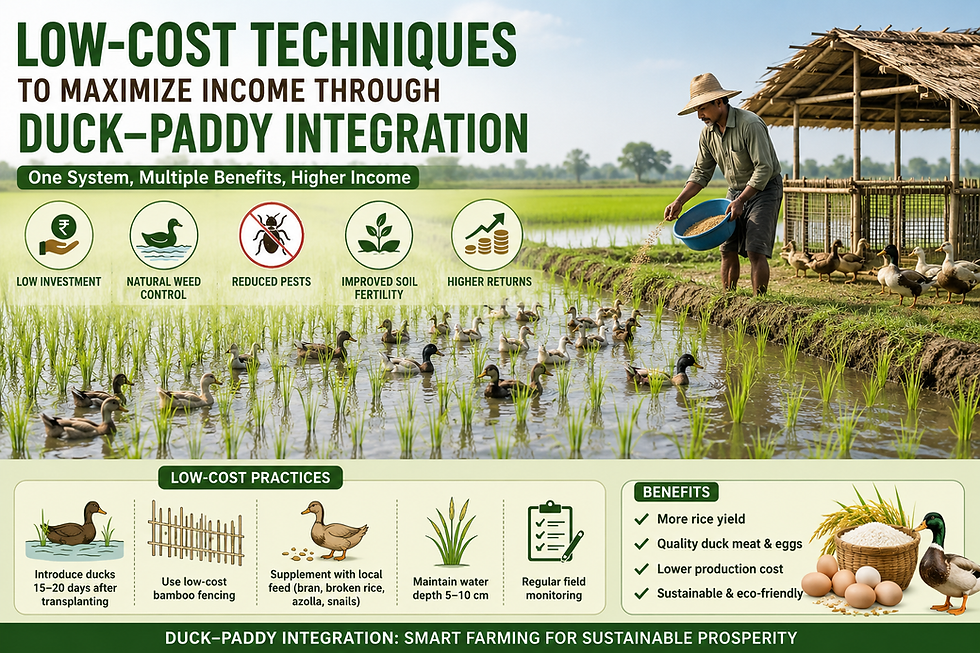
Low-Cost Techniques to Maximize Income Through Duck–Paddy Integration

Integrated Duck–Paddy Farming is an age-old practice that is gaining high attention due to its low investment, high returns and eco-friendly nature. By allowing ducks to forage in paddy fields, farmers can reduce input costs, improve soil fertility and increase rice yield while earning an additional income from meat and egg production.
This article explains practical, low-cost techniques that can help farmers maximize profits from a Duck–Paddy integrated system.
Benefit at a Glance: A well-managed integrated system can provide:
15–20% increase in paddy yield
50–60% reduction in chemical fertilizer use
Up to 100% saving on pesticide use
Additional income from eggs, meat and manure
Better soil aeration and weed control through natural duck activity
These benefits make the system ideal for small and marginal farmers.
Low-Cost Techniques for High Income:
Choose the Right Duck Breed: Selecting hardy, foraging-friendly breeds reduces feeding cost significantly.
Recommended Low-Cost Breeds
Khaki Campbell – high egg production, good foragers
Indian Runner Duck – lean body, excellent mobility in wetlands
Desi/Local Ducks – naturally adapted, lowest management cost
These breeds find a large portion of their feed from the paddy ecosystem.
Optimize Duck Stocking Rate: To reduce cost while maximizing benefit:
250–300 ducks per hectare of paddy is ideal.
Too few ducks = less effect on pest/weed control
Too many ducks = crop damage and higher feed requirement
Correct stocking ensures balanced ecosystem management.
Reduce Feed Costs with Natural Foraging: Ducks naturally feed on:
Insects
Golden apple snails
Weed seedlings
Leftover grains
Small aquatic organisms
Technique to Maximize Foraging
Introduce ducks into the field 10–15 days after transplanting
Allow ducks to stay in the field for 4–5 hours daily
Rotate access to maintain healthy foraging zones
This can save 40–60% on feed cost.
Utilize Duck Manure for Soil Fertility: Duck droppings act as natural fertilizer.
Benefits:
Releases nutrients slowly
Boosts soil microbes
Reduces urea requirement
Farmers practicing duck–paddy integration often reduce fertilizer use by half, directly
saving money.
Build a Low-Cost Night Shelter: A simple, functional shelter helps protect ducks while keeping cost low.
Low-cost materials
Bamboo/wooden poles
Netting/jute bags
Thatch/HDPE sheet roof
Design Tips
Raised platform to avoid moisture & flooding
Proper cross ventilation
Use local materials to reduce cost
A community or group shelter can further reduce cost per farmer.
Organic Pest & Weed Control: Ducks provide free “pest control” services.
They naturally control:
Brown planthopper
Stem borer larvae
Leaf folder
Weeds (by disturbing young weed shoots)
This eliminates the need for pesticides, saving ₹1,500–3,000 per acre depending on
region.
Integrated Income Streams: Maximize profit through multiple outputs:
Eggs
Sale of table eggs
Fertile eggs for hatching units
Duck egg pickles (value addition)
Meat
Free-range duck meat fetches higher market price
Festival season sales can increase income
Manure
Duck manure is in high demand for organic farms
Dry it and pack for extra income
Value-added products
Smoked duck meat
Duck jerky
Egg-based bakery items (with local partnerships)
Even small-scale farmers can generate ₹20,000–50,000 extra annually using these
methods.
Water Management for Sustainability: The duck–paddy system works best when water is managed well.
Low-cost strategies
Maintain 3–5 inches water depth
Create small in-field trenches where ducks can rest
Use rainwater or reused irrigation water where possible
This ensures healthy paddy and healthy ducks.
Community-Based Approaches to Reduce Costs: For small farmers, collaboration can reduce cost significantly.
Collective approaches
Bulk purchase of ducklings
Shared night shelter
Joint marketing of eggs/meat
Shared training and veterinary support
Collective models strengthen rural livelihoods and reduce risk.
Duck–Paddy integration is a profitable, eco-friendly and low-cost farming practice. Farmers can extremely reduce input costs while increasing rice yield and generating additional income from ducks.
By focusing on:
Breed selection,
Stocking management,
Natural foraging,
Low-cost shelters and
Value addition,
Farmers can develop a self-sustaining and high-income integrated farming system.


Comments