
Restoring Soil Fertility with Goat and Sheep Dung: Nature’s Organic Fertilizer

Soil is the foundation of agriculture, yet in many farming regions soil fertility is gradually declining due to excessive use of chemical fertilizers, poor organic matter management and continuous cropping. This has led to reduced soil productivity, loss of beneficial microorganisms and increasing dependency on costly external inputs. In this context, traditional and natural sources of soil nutrients are regaining importance. Among them, goat and sheep dung stands out as a highly valuable organic fertilizer that can play a crucial role in restoring soil fertility and supporting sustainable agriculture.
Importance of Soil Fertility in Sustainable Agriculture: Healthy soil is rich in organic matter, balanced nutrients and diverse microorganisms. It supports plant growth, improves water retention and enhances crop productivity. However, continuous application of chemical fertilizers often leads to soil degradation, reduced organic carbon and disruption of soil microbial life. Restoring soil fertility requires the integration of organic inputs that nourish both the soil and the crops and livestock manure is one of the most effective solutions.
Goat and Sheep Dung: A Nutrient-Rich Organic Resource: Goat and sheep manure is widely recognized for its high nutrient content and excellent soil conditioning properties. Compared to many other livestock manures, goat and sheep dung is relatively dry and pellet-shaped, making it easy to collect, store, transport and apply in fields.
This manure typically contains essential plant nutrients such as:
Nitrogen (N) 0.7% for plant growth and leaf development
Phosphorus (P) 0.3% for root development and flowering
Potassium (K) 0.9% for plant health and resistance to stress
Organic carbon that improves soil structure and fertility
Because of its balanced nutrient composition, goat and sheep manure acts as a slow-release organic fertilizer, gradually supplying nutrients to crops while improving long-term soil health.
Improving Soil Structure and Organic Matter: One of the major benefits of goat and sheep dung is its ability to increase soil organic matter. Organic matter improves soil structure by enhancing aggregation, which leads to better aeration and water infiltration. As a result, the soil becomes more fertile and capable of sustaining crop production.
Fields treated with organic manure often show:
Improved soil texture and structure
Higher water-holding capacity
Reduced soil erosion
Better root penetration and crop growth
These improvements are especially important in regions where soils are degraded or have low organic carbon levels.
Enhancing Soil Microbial Activity: Healthy soil depends on a vibrant community of microorganisms such as bacteria, fungi and earthworms. These organisms help decompose organic materials, release nutrients and improve soil fertility. Goat and sheep dung provides the organic substrate needed for these beneficial microbes to thrive.
By applying organic manure regularly, farmers can restore biological activity in the soil, which enhances nutrient cycling and supports sustainable crop production.
Supporting Organic and Natural Farming: With the growing demand for chemical-free food, many farmers are shifting towards organic and natural farming systems. Goat and sheep manure fits perfectly into these systems because it is a natural input that improves soil fertility without harming the environment.
Using goat and sheep dung in farming can help:
Reduce dependency on chemical fertilizers
Lower input costs for farmers
Improve soil health over time
Produce healthier and more sustainable crops
This makes it an ideal resource for farmers practicing organic agriculture and regenerative farming.
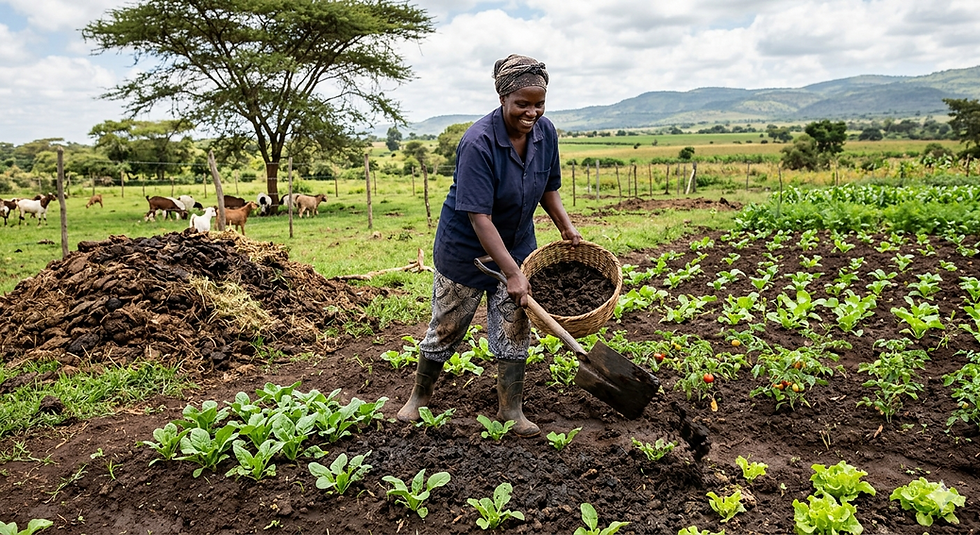
A Valuable Resource in the Livestock-Based Circular Economy: Goat and sheep farming is already an important livelihood activity for many rural households. In addition to providing meat, milk and income, these animals also produce manure that can be used to enhance agricultural productivity. This creates a circular farming system where livestock and crops support each other.
Farmers can utilize goat and sheep dung in several ways:
Direct application in crop fields
Compost preparation
Vermicomposting
Organic manure production for sale
This not only improves soil fertility rather creates conducive environment for the microorganism responsible for the soil health but also creates additional income opportunities for rural communities.
Restoring soil fertility is essential for ensuring long-term agricultural sustainability and food security. Goat and sheep dung, often considered a by-product of livestock farming, is in fact a powerful natural fertilizer that enriches soil nutrients, enhances organic matter and supports healthy microbial activity.
By integrating goat and sheep manure into farming systems, farmers can rebuild soil health, reduce reliance on chemical inputs reducing input cost and move towards more resilient and sustainable agriculture. In this way, small livestock can play a big role in protecting our soil health and strengthening the future of farming.



Comments