
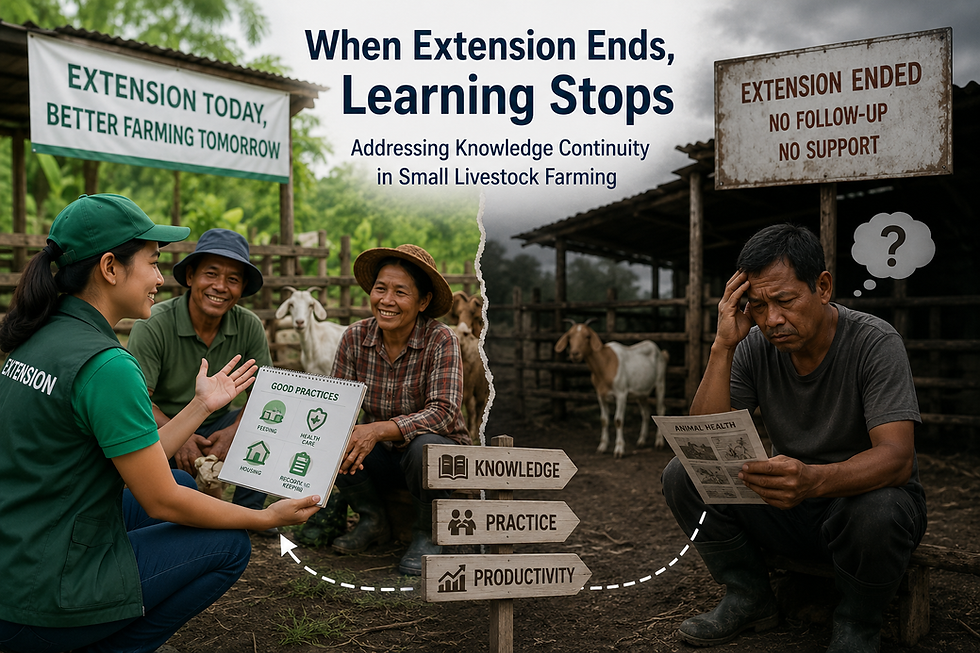
When Extension Ends, Learning Stops Addressing Knowledge Continuity in Small Livestock Farming

Small livestock farming—goats, sheep, backyard poultry, indigenous poultry and duckery—supports millions of marginal and landless households across rural India. Despite its proven potential for income generation, nutritional security and women’s empowerment, the sector continues to suffer from a persistent and often overlooked challenge: knowledge discontinuity once formal extension support ends.
Most livestock development programs emphasize short-term training, exposure visits or project-based advisory services. However, when these interventions conclude, farmers are frequently left without reliable, accessible and context-specific reference materials to guide their day-to-day decision-making. As a result, learning stops, adoption declines and productivity gains fail to sustain.
The Limitations of Conventional Extension Systems: Public and project-based livestock extension systems face multiple structural constraints:
Low extension worker-to-farmer ratios, particularly in remote and tribal areas
Event-based knowledge transfer, limited to training days or project timelines
High dependence on verbal communication, with minimal written or visual reinforcement
Weak follow-up mechanisms once projects are completed
For small livestock farmers, whose enterprises require daily management decisions related to feeding, breeding, housing, health care and marketing, this fragmented approach is inadequate. Without continuous access to trusted guidance, farmers revert to traditional practices—many of which are low-yielding or risky under changing climatic and disease conditions.
Why Knowledge Continuity Matters in Small Livestock Farming: Small livestock systems are highly dynamic. Disease outbreaks, seasonal feed shortages, breeding cycles, market fluctuations and climate stress demand timely and accurate responses. Knowledge continuity ensures that farmers can:
Recognize early signs of disease and take preventive action
Adjust feeding and housing practices based on seasonality
Make informed breeding and culling decisions
Improve product quality and market readiness
Reduce dependence on costly external advisory services
In the absence of continuous learning tools, even well-trained farmers struggle to apply knowledge consistently over time.
Reference Materials (The Missing Link): One of the most effective yet underutilized solutions to this challenge is the development and dissemination of practical reference materials tailored to small livestock value chains.
Unlike one-time trainings, reference materials:
Act as permanent knowledge companions for farmers and community resource persons
Enable self-learning and peer learning at the village level
Standardize best practices across geographies
Support frontline workers such as Pashu Sakhis, para-vets and producer group leaders
Ensure continuity beyond project funding cycles
When designed well—using local language, illustrations, step-by-step guidance and field-tested practices—reference materials become a powerful extension substitute.
Addressing Knowledge Continuity (A Value Chain Perspective): Knowledge gaps exist at every stage of the small livestock value chain:
Input stage: breed selection, housing design, feed formulation
Production stage: health management, breeding, record keeping
Post-production stage: grading, storage, processing
Market stage: price discovery, aggregation, negotiation
Reference materials that integrate the entire value chain help farmers move from subsistence rearing to enterprise-oriented livestock farming.
The Role of TGT Global Development Services Pvt. Ltd.: Organizations with deep field engagement are uniquely positioned to address this gap. TGT Global demonstrates how practitioner-led institutions can institutionalize livestock knowledge.
By converting field experiences, training modules and community innovations into structured reference materials, TGT Global:
Bridges the gap between theory and practice
Supports long-term learning for farmers and community cadres
Strengthens Pashu Sakhi and community extension models
Enhances the sustainability of CSR and development investments
Creates reusable knowledge assets for scaling impact
Such materials not only support farmers but also improve the effectiveness of trainers, NGOs and implementing agencies.
Toward a Knowledge-Embedded Livestock Ecosystem: Ensuring knowledge continuity requires a shift in how livestock programs are designed:
Treat reference materials as core project outputs, not add-ons
Budget for development, translation and periodic updating of materials
Combine physical manuals with digital and audio-visual formats
Embed reference tools within community institutions and producer groups
Encourage farmer-to-farmer learning using standardized guides
This approach transforms extension from a service into a self-sustaining knowledge ecosystem.
When extension ends, learning should not stop. For small livestock farmers to thrive in an increasingly complex and risk-prone environment, they need continuous access to practical, trusted and context-specific knowledge.
Reference materials are not merely documents—they are enablers of resilience, productivity and creates dignity in small livestock farming. Institutions like TGT Global Development show that when knowledge is embedded into the value chain, development outcomes endure long term even after projects conclude.


Comments